

DepEd Regional Athletic Association Meet (RAAM) – Swimming Competition
Lipa City, Philippines | March 8–12, 2026
The recently concluded DepEd Regional Athletic Association Meet (RAAM) swimming competition held in Lipa City from March 8–12, 2026 was another successful gathering of young athletes from different provinces in the region. The event showcased the dedication, talent, and hard work of student-athletes, coaches, and organizers.
This article is written for educational purposes and healthy discussion regarding some officiating situations observed during the meet. The intention is not to criticize or malign any official, but rather to help inform and educate coaches, swimmers, parents, and officiating officials—especially as swimming continues to grow rapidly in the Philippines.
2026: Growth of Grassroots Swimming in the Philippines
In recent years, there has been a noticeable boom in grassroots swimming programs across the country, particularly in Metro Manila and nearby towns of Rizal Province. Swimming clubs and developmental programs are expanding, and participation in competitions is steadily increasing.
In some months, two or even three swimming competitions are held simultaneously, yet participation remains high, with many swimmers competing in each event.
This growth is very encouraging for the development of Philippine swimming. However, it also highlights the need to continuously improve and uplift the standard of officiating in swimming meets. As participation increases, maintaining consistent and accurate officiating becomes even more important to ensure fairness for all athletes.
Case for Discussion: 4 × 50 Meter Medley Relay Exchange
One of the situations that generated discussion during the meet occurred in the 4 × 50 meter medley relay event.
During the race, the team from Rizal Province was disqualified for an alleged early take-off by the third swimmer during the relay exchange.
Several parents who were present recorded the race on video. According to the footage shared among coaches and spectators, the relay exchange appeared to have been executed properly. The videos suggested that the outgoing swimmer’s feet remained in contact with the starting platform until the incoming swimmer touched the wall.
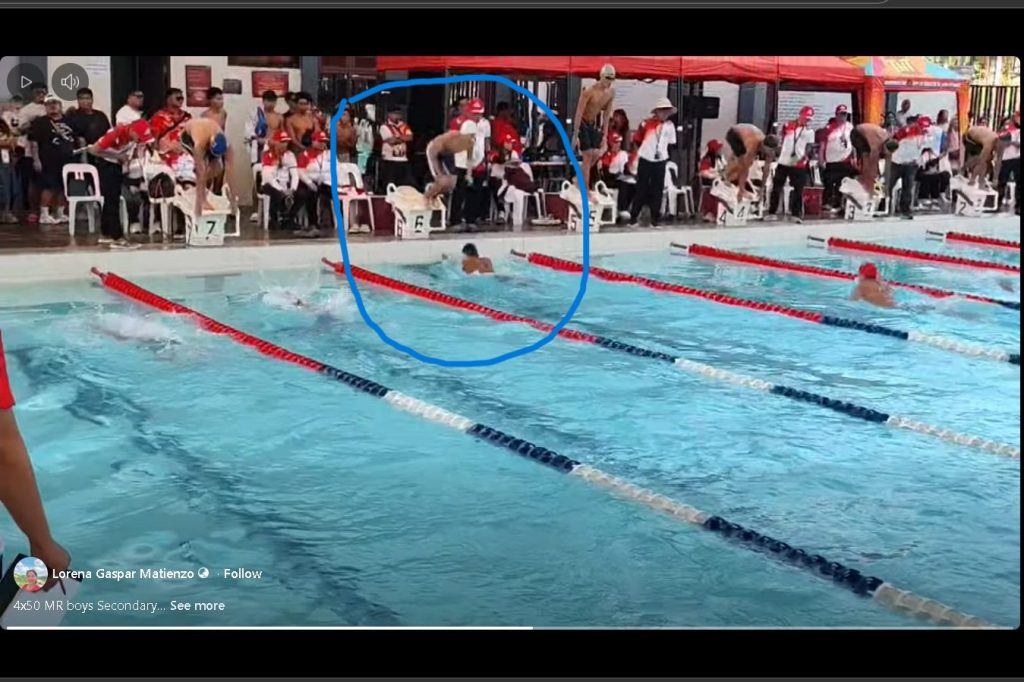
Because of this, the team’s coach submitted a formal protest regarding the disqualification. It was later reported that the officials reviewed the available footage and decided to uphold the disqualification.
For further review, I also examined the video by casting it on a larger television screen. From my personal observation of the footage, the exchange appeared to be executed correctly. However, it is important to remember that official decisions during competitions are based primarily on the observations of the assigned officials on deck.
To encourage discussion and learning, I shared the video clip on Facebook with the caption:
“For educational purposes only. Was Lane 6 correctly disqualified?”
The post generated significant interest, receiving nearly 2,000 views and many comments from coaches, swimmers, and even Filipino coaches working abroad. The discussion highlighted how valuable these situations can be in educating the swimming community about the rules and officiating procedures.
Relevant Rule on Relay Exchanges
According to the rules of World Aquatics, the governing body for international aquatic sports, the rule regarding relay exchanges states:
World Aquatics Swimming Rule 10.4.5
“Until an athlete touches the wall to complete their quarter of the total race distance, the feet of the athlete in the same relay team who is next in order to compete must remain in contact with the starting platform.”
In simple terms, this means that the outgoing swimmer must keep at least one foot in contact with the starting platform until the incoming swimmer touches the wall.
Relay exchanges are often decided within fractions of a second, making them one of the most challenging aspects of officiating in swimming competitions.
This is the other videos posted by a parent in her own facebook page which also clearly shown that there is no early take off committed. Sad to say the officials after reviewing the video still said that there is an early take off violation. The RAAM Meet was all done manualy with 3 timer per lane. We do not know whose judge disqualify the team and where he was positioned. We speculate that the officiating official who disqualified base the DQ to the movement of the the outgoing swimmers without seeing that the feet is still in the starting block.
Important Principle in Officiating
Officials are trained to “give the swimmer the benefit of the doubt.”
If the official did not clearly see the violation, they should not make the disqualification.
This principle is emphasized in the rules of World Aquatics for fair and consistent officiating.
Now we know that a judgement call has been made. A judgment call is based on the official’s observation and interpretation of the rules. It depends on what the official sees during the race and the violation slip was submitted to the referee. Can a judgement call be overruled or rectified? Can a Judgment Call Be Overturned?
Generally, no.
If the decision was made by an official who clearly observed a violation, the Referee normally upholds the call, because it is based on the official’s observation.
However, the Referee has the authority to review the situation and may rectify or overturn the decision if:
- The official did not have a clear view of the action.
- The report of the violation is incorrect or inconsistent.
- Another official with better jurisdiction clearly observed something different.
- There was a misapplication of the rules.
Anyway, a decision has been made, and RAAM has been concluded. Four swimmers, in my opinion, have been deprived of their medals. What the Video Can Still Be Used For Even if it cannot officially overturn a decision, videos can still be valuable for:
• Educational discussions
• Reviewing officiating situations for training
• Helping coaches teach swimmers correct techniques
• Improving future officiating standards
Hopefully officiating clinics use spectator videos as training materials to analyze difficult calls such as relay takeoffs or stroke violations.
Suggestions and Recommendations
Since Southern Tagalog is considered one of the powerhouses in swimming in the Palarong Pambansa, it is recommended that future regional meets consider improving the technical aspects of competition management.
One possible step is to borrow or utilize the automatic timing system from the Philippine Sports Commission during major competitions. The use of automatic timing systems greatly improves the accuracy, transparency, and credibility of race results, especially in events where finishes or relay exchanges are very close.
In addition, organizers may also consider investing in semi-automatic timing and judging systems, such as those produced by well-known swimming equipment brands like Dolphin Timing, WylasTime Systems, Swimtopia Swimming Software, or Time Drops. These systems help assist officials in recording accurate times and relay exchanges even when a fully automatic system is not available. If the above suggestion is not feasible or impossible, then provide or assign officials to take videos at both ends of the pool and on both sides to ensure a clear view of what is happening.
Finally, it is equally important to strengthen and deepen the training of swimming officials through regular seminars, certification programs, and rule updates. Continuous education will help ensure that officials remain well-equipped to handle the increasing number and level of competitions while maintaining fairness and consistency in officiating.
By combining better technology and continuous officiating education, the region can further enhance the quality and integrity of swimming competitions and continue to produce athletes who can proudly represent the region at the national level. Assign officials who will take video footage of the competition especially in all the 50 meters sprint in the absence of automatic timing system. Study the video footage in a bigger screen preferably in laptop and carefully watch it before making a decision.